Overview:
Recently, the research groups led by Prof. Tao Li and Assoc. Prof. Wange Song at the College of Engineering and Applied Sciences, Nanjing University, achieved the optimal solution to the adiabatic evolution problem in discrete systems—the Adiabaticity Control Limit (ACL)—by introducing an inverse adiabaticity control strategy. Using stimulated Raman adiabatic passage (STIRAP) implemented in silicon waveguides, they experimentally demonstrated that the ACL enables the simultaneous realization of optimal compactness and robustness. This work, entitled “Approaching Optimal Light Evolution at Adiabaticity Control Limit in Inverse-Designed Waveguides,” was published in the top-tier physics journal Physical Review Letters (Phys. Rev. Lett. 135, 266601 (2025)). The first author is Xuanyu Liu, a Ph.D. candidate (direct doctoral track, class of 2023) at the College of Engineering and Applied Sciences, Nanjing University. The corresponding authors are Prof. Tao Li and Assoc. Prof. Wange Song. This research was conducted under the guidance of Academician Shining Zhu.
Background:
The dynamical evolution of physical states is central to quantum information processing and integrated photonics. A key challenge is to accelerate state evolution while maintaining high fidelity, thereby reducing device size. Conventional adiabatic protocols can suppress mode crosstalk effectively, but they typically require excessively long evolution times or device lengths. By contrast, shortcuts to adiabaticity (STA) aim to accelerate evolution, yet often at the cost of reduced robustness and increased sensitivity to noise.
For a long time, evolution duration and mode crosstalk have been viewed as mutually competing factors. In principle, there exists a fundamental bound that balances the two—the adiabaticity control limit (ACL), defined as the shortest possible duration with minimal mode crosstalk during evolution. However, conventional forward-design approaches lack quantitative control over crosstalk, making it difficult to pinpoint this physical limit. As a result, the designed structures often fail to reach the optimal solution and cannot achieve a perfect balance between compactness and robustness.
Innovative Study:
This study proposes an inverse adiabaticity control framework by introducing tolerable crosstalk as a new optimization dimension, enabling quantitative regulation of eigenmode crosstalk during evolution and thereby allowing precise identification of the ACL. Taking STIRAP as an example, the researchers construct a global landscape of optimal solutions for adiabatic evolution and, for the first time, reveal that on the ACL the system can achieve the shortest evolution time and the highest robustness simultaneously. The superiority of this method is experimentally demonstrated in silicon photonic waveguides, where the origin of robustness degradation commonly observed in conventional STA schemes is clarified. The results demonstrate a universal strategy for achieving optimal compactness and robustness by eliminating redundant evolution, providing a new paradigm for integrated photonic device design.
The principle of inverse design is illustrated in Fig. 1. The evolution objective is quantified by the fidelity between the output state and the target state, which is jointly governed by the evolution duration and mode crosstalk. Conventional approaches cannot quantitatively control crosstalk and therefore struggle to balance these two factors. In contrast, inverse design globally optimizes the maximum fidelity under combined constraints on evolution time and tolerable crosstalk, revealing four representative evolution regimes: adiabatic evolution, redundant evolution, insufficient evolution, and STA-like evolution. When the fidelity approaches unity, the system reaches the ACL, where the target state is attained with the shortest possible duration and minimal crosstalk, without redundancy. While conventional forward-designed structures often fall into redundant evolution, inverse design overcomes this limitation and opens a new route toward efficient and robust state control.
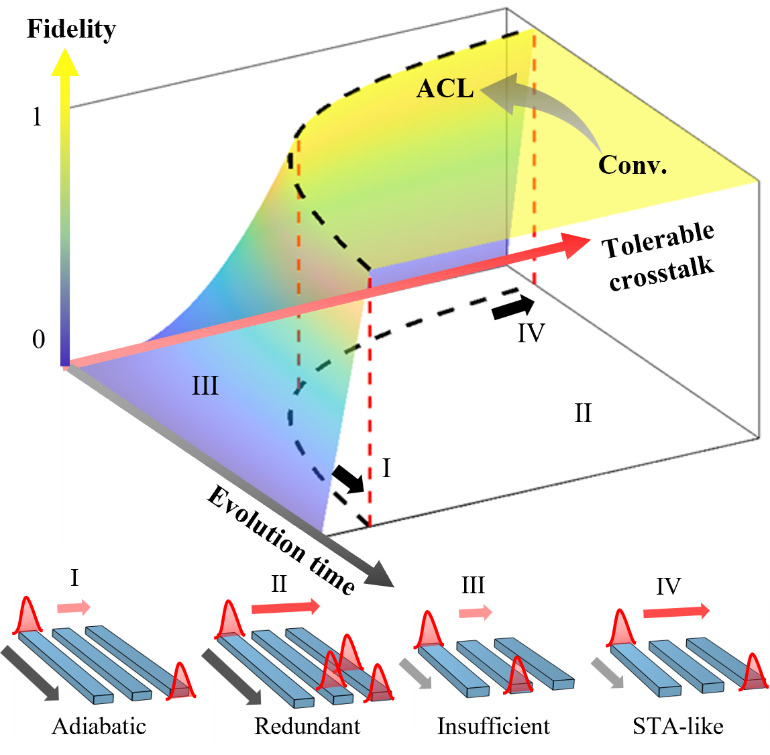
Fig. 1. Schematic illustration of inverse adiabaticity control and four typical evolution regimes.
The STIRAP model describes noise-resilient adiabatic population transfer mediated by a quantum dark state. This process can be accurately implemented in optical waveguide arrays using coupled-mode theory, as shown in Fig. 2(a). The coupling coefficients c₁ and c₂ are modulated via interpolation points: c₁ increases from 0 to its maximum value, while c₂ varies in the opposite manner. Fidelity characterizes the overlap between the output state and the target state (Fig. 2(b)). In an ideal adiabatic evolution, the system continuously follows the dark state; in practice, however, transitions to other modes inevitably occur during evolution (Fig. 2(c)), and high-fidelity output requires dynamic reconvergence. To quantify deviations from adiabaticity, the average crosstalk is defined, and an optimization problem is formulated in which fidelity is maximized using a gradient-descent algorithm under the constraint that the average crosstalk remains below a specified tolerable upper bound.
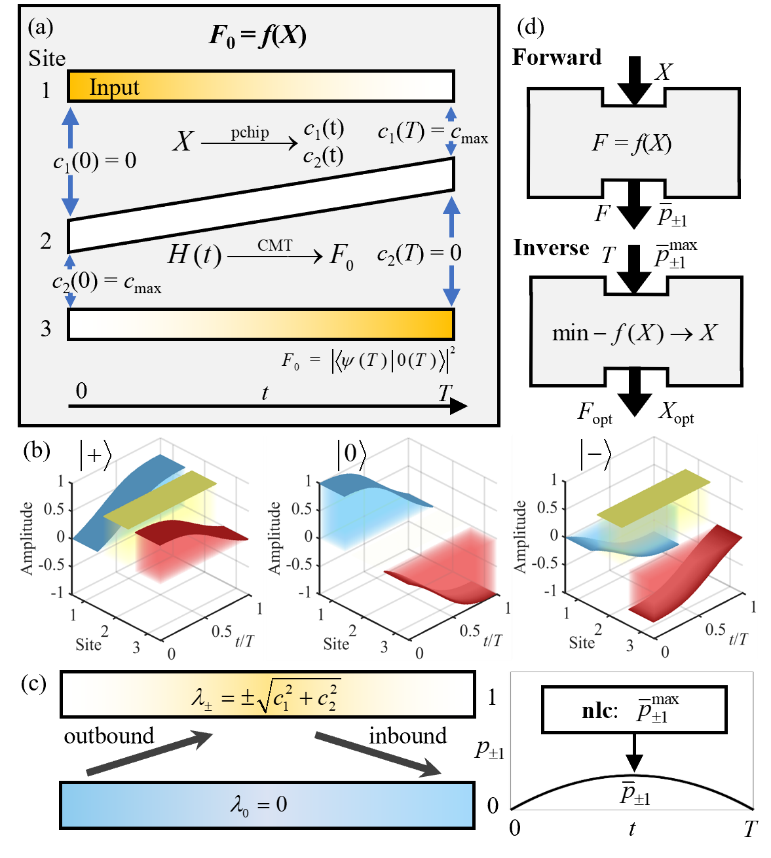
Fig. 2. Inverse design in STIRAP. (a) Functional framework for implementing energy transfer in optical waveguides. (b) Schematic illustration of mode-distribution evolution during STIRAP. (c) Left: evolution of eigenstate populations; right: nonlinear constraint on average crosstalk. (d) Comparison between forward design and inverse design: forward design directly produces an output, whereas inverse design searches for the optimal solution under specified parameter constraints.
The simulation results (Fig. 3(a)) reveal the optimal fidelity distribution obtained by inverse design over the parameter space, in agreement with the theoretical predictions in Fig. 1. The four marked evolution strategies exhibit pronounced differences in their zero-mode population dynamics (Fig. 3(b)): Case I (adiabatic evolution) maintains a high population throughout; Case IV (STA-like evolution) accelerates transfer via controlled nonadiabaticity; Case III (insufficient evolution) fails to complete transfer due to insufficient duration; and Case II (redundant evolution) introduces ineffective oscillations. These results indicate that the ACL essentially represents the fastest achievable state evolution under a given crosstalk constraint. To verify feasibility, four corresponding structures were fabricated on a silicon-on-insulator (SOI) waveguide platform (Fig. 3(c)). Both full-wave simulations (Figs. 3(e)–3(h)) and experimental measurements (Figs. 3(i)–3(l)) show excellent agreement with theoretical predictions, confirming the effectiveness of the inverse design strategy in photonic systems.
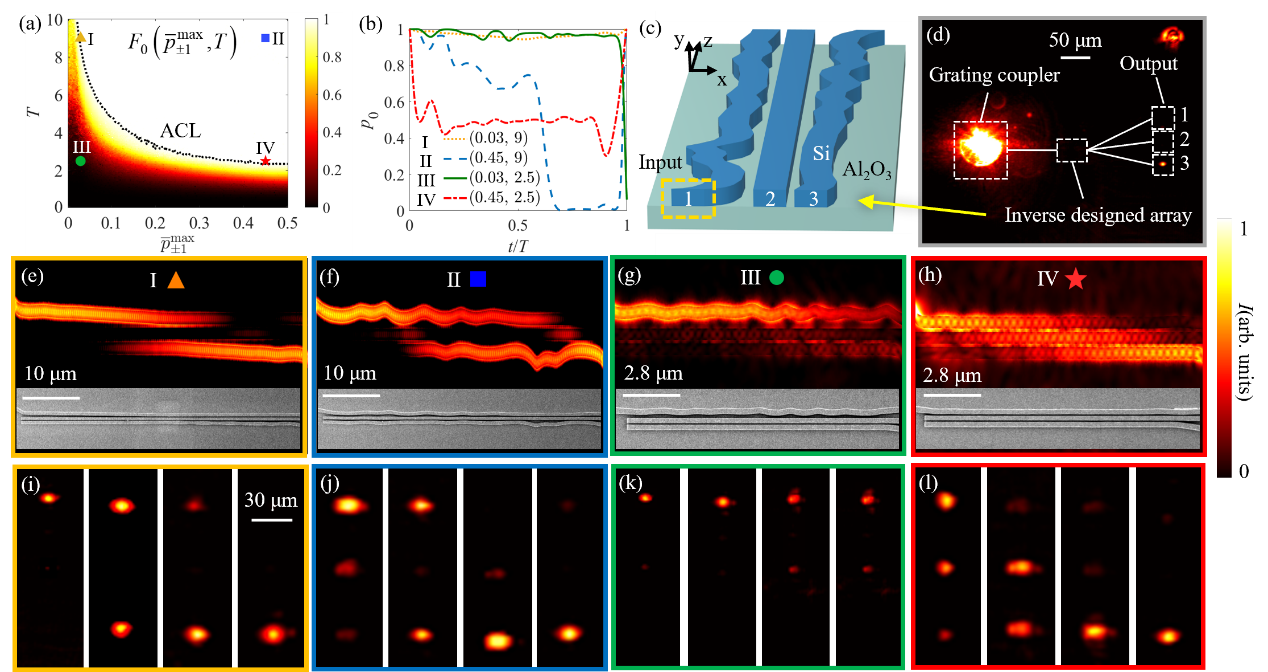
Fig. 3. Results and experimental verification. (a) Phase diagram of optimal fidelity as a function of evolution time and tolerable crosstalk. (b) Evolution of zero-mode population during propagation. (c) Schematic of the silicon waveguides. (d) CCD-recorded light propagation in the waveguide array. (e–h) Simulated optical fields in optimized waveguides with corresponding SEM images. (i–l) Output intensity distributions at different propagation distances.
Compared with conventional designs, inverse design enables precise localization of the ACL and achieves the most compact evolution without redundancy. Under strong disorder perturbations, the standard deviation of fidelity is significantly reduced (Fig. 4(a)); under a fixed crosstalk constraint, the ACL simultaneously achieves the highest fidelity and the lowest fluctuation (Fig. 4(b)). This reveals the dual optimality of the ACL: under the same crosstalk constraint, it yields the shortest evolution time (optimal compactness); under the same time constraint, it yields the smallest average crosstalk (highest robustness). Performance degradation in conventional methods originates from additional crosstalk introduced by deviation from the ACL. This finding provides a critical guideline for integrated photonics and quantum computing.
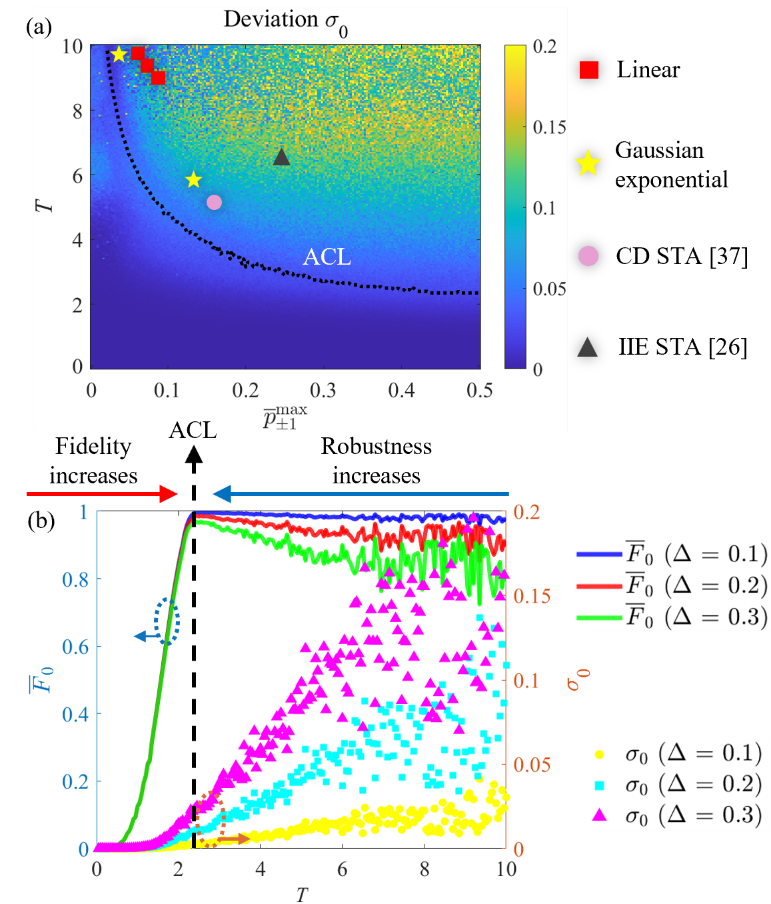
Fig. 4. Robustness advantage of the ACL. (a) Distribution of fidelity standard deviation under strong disorder. (b) Optimal robustness achieved at the ACL.
Through inverse design, the researchers establish a new control scheme for obtaining optimal solutions to nonadiabatic state evolution. Using STIRAP as a representative example, inverse design enables high-fidelity target output, which is experimentally verified in integrated silicon waveguides. The key breakthrough of this work lies in the first access to the adiabaticity control limit, where evolutionary redundancy is eliminated and optimal robustness is achieved simultaneously, providing a new theoretical foundation for optimizing quantum and photonic devices.
This work was supported by the National Key Research and Development Program of China, the National Natural Science Foundation of China, and the Dengfeng Project B of Nanjing University.
Article link: https://journals.aps.org/prl/abstract/10.1103/zwt9-79zy
(Contributed by the research group)